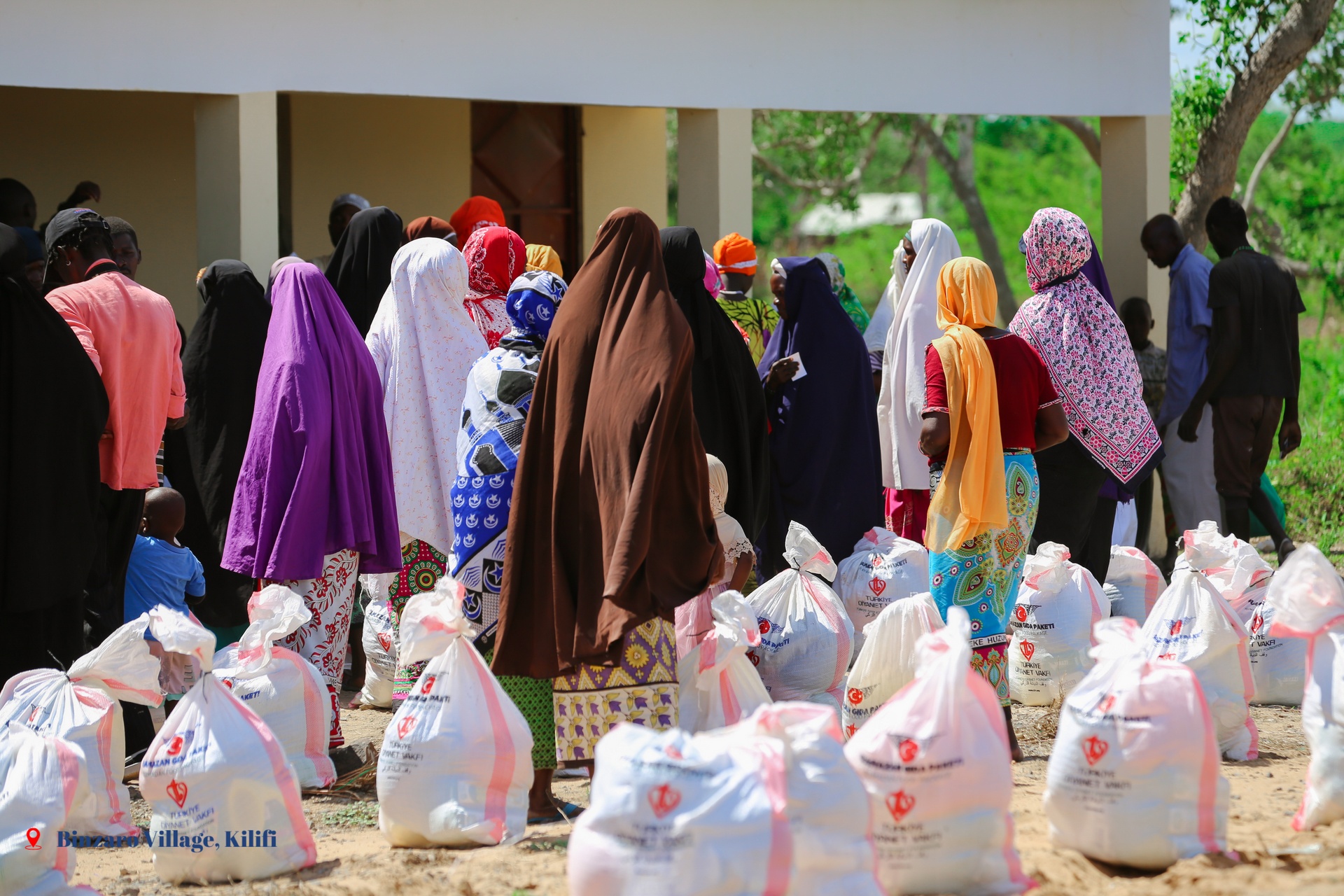
Fadhili, which translates to kindness in Swahili, encompasses various charitable acts within the Islamic faith. One example of this is the distribution of food during the holy month of Ramadhan and the meat distribution during the Idd ul Adh’ha (hajj festival) across the country.
Additionally, Fadhili includes acts such as Aqiqah, which is the Islamic tradition of sacrificing an animal in honor of a newborn, as well as any other form of donation that may be requested by a donor for a special occasion. These acts of kindness are in line with the principles and traditions of Islam and are an important aspect of the faith.
Ramadhan Annual Iftar Project
Distribution of food packs during the month of Ramadhan is a standing tradition for most if not all Islamic guided organizations all over the world. For us as Busara, this was the first initiative we took up and now, a standing annual tradition under our Fadhili programs.
The practice is highly recommended for both religious reasons as well as strategic reasons. According to the teachings of our prophet Muhammed (pbuh).
Zayd ibn Khalid reported: The Messenger of Allah, peace and blessings be upon him, said: “Whoever helps break the fast of a fasting person, he will have the same reward as him without decreasing anything from the reward of the fasting person.” Source: Sunan al-Tirmidhī 807, Grade: Sahih
These distribution exercises also give us a chance to interact with various communities countrywide and we can identify existing challenges that we may then tackle throughout the year. From last year only, we were exposed to major clean water challenges in various regions including Kwale and Tana River, of which we have been working towards solving. We have so far had the opportunity to implement more than 20 shallow wells, 4 mosque renovation and various donations towards children’s homes.
Udh’hiya Annual Program
Udhiya, also known as qurbani or dhabiha, is a religious practice in Islam that involves the sacrifice of an animal in remembrance of the sacrifice made by Prophet Ibrahim (peace be upon him). The act of sacrifice is done during the Islamic festival of Eid ul-Adha, which is celebrated by Muslims around the world. The practice of Udhiya is an important part of Islamic faith, and it is seen to show devotion to Allah and to remember the commitment of Prophet Ibrahim. Udhiya is a way to express gratitude to Allah for all the blessings bestowed upon us. It is a reminder of our commitment to the Divine and a way to demonstrate that we are willing to give up something that is precious to us. The act of sacrifice also shows that we understand the suffering of others and are willing to show compassion and mercy towards those who are less fortunate than us, aligning well with Busara’s objectives and vision.
The animal chosen for sacrifice must be healthy, of a certain age, and of a certain gender. The most common animal chosen is a sheep, but it can also be a goat, a cow, or a camel. The animal must be slaughtered in a humane manner, and the meat must be divided.
Aqiqah and sadaqa
This is yet another practice of the Islamic faith that Busara keeps alive under our Fadhili programs. It is a sunnah (tradition) of the Prophet Muhammad (peace be upon him), which is practiced by many Muslims around the world. This tradition involves the sacrificing of an animal such as a sheep, goat or cow and the meat is shared among the family, friends, and the poor.
It is held during the 7th day of the newborn baby’s life, although it can be celebrated any day after the birth. The practice of Aqiqah is related to the verse of the Quran which states “Let them (the sacrificial animals) be for you a reminder of Allah’s mercy upon you and give glad tidings to the doers of good.” (Quran 22:36). This is seen as a way of thanking Allah for the blessing of a child and expressing gratitude for the blessing of life. Aqiqah has a spiritual aspect to it, as it serves as a reminder of Allah’s mercy and blessings. It is seen as a way of showing gratefulness to Allah and expressing appreciation for the gift of life. It is a way of celebrating the birth of a child and expressing the joy of having a new addition to the family.
As another way to assist the less fortunate in our community, Busara also distributes meat as sadaqa (charity). It is a common practice among the Muslim community to sacrifice an animal, typically a goat, sheep, or cow as a sadaqa (charity). It is done as an act of thanksgiving for a blessing that Allah has bestowed, such as an achievement someone has been seeking, such as attaining a new job or buying a car etc.
This is what many people do as an act of thanksgiving for a blessing from Allah, as He has enabled them to attain such a goal. In other instances, others would do such a charity when they come back from a journey, and they invite their relatives and neighbors, or send it to the less fortunate in the community as an act of thanksgiving to Allah for their safe arrival. When the Prophet (peace and blessings of Allah be upon him) came back from a journey he would sacrifice a camel and invite the people to eat. (Narrated by al-Bukhaari, 3089). Majmoo’ Fataawa al-Shaykh Ibn Baaz, 5/388.
The animal chosen for sacrifice must be healthy, of a certain age, and of a certain gender. The most common animal chosen is a sheep, but it can also be a goat, a cow, or a camel. The animal must be slaughtered in a humane manner, and the meat must be divided.
In – Kind Gifts
At Busara, gifting is one way to reach out to the community and spread hope and love. This can be in the form of clothes, shoes, school supplies, books and much more. Sharing gifts in a community is an important way to show appreciation, love, and gratitude for the people around us. Gifts are a way to show people that we care and that we are thinking of them. Not only do gifts demonstrate our feelings, but they also create a sense of community and connection.
It could be a simple gesture like an inspirational card/message or something more elaborate like a gift box filled with treats or even furniture! Regardless, it is a way to show that we recognize them and acknowledge them. Gifts are a great way to show support and encouragement. When someone gives us a gift, it is a sign that they believe in us and want us to succeed. It is a sign that they believe in our dreams and want to help us reach our goals. This kind of recognition and support can be incredibly motivating and inspiring. Furthermore, gifts are a way to build meaningful relationships.
Participate in Fadhili Program
Be part of our Fadhili Program by offering a kind donation, or participating in person.
Become part of the occasion
The Fadhili program, which translates to kindness in Swahili, allows for individuals to participate in a variety of ways. One way is to contribute in person by participating in the food and meat distribution during the Ramadhan and Idd ul Adh’ha (hajj festival) respectively. Another way to participate is through financial contributions. This can be done by donating money to support the program and its initiatives.